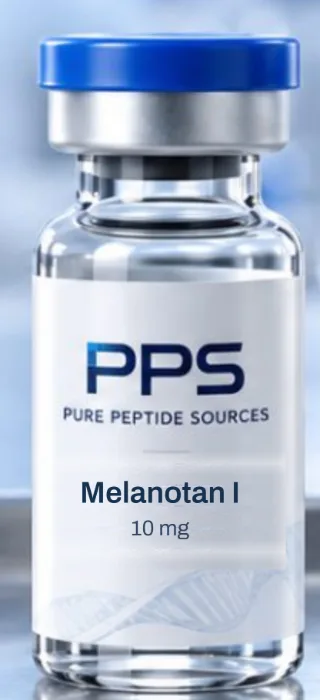
Melanotan I
10 mg
Linear alpha-MSH analogue, 10 mg per vial.
- Storage
- Refrigerated
Comparison
Both are analogues of alpha-melanocyte-stimulating hormone. The difference is receptor selectivity, and it is the whole reason both exist.
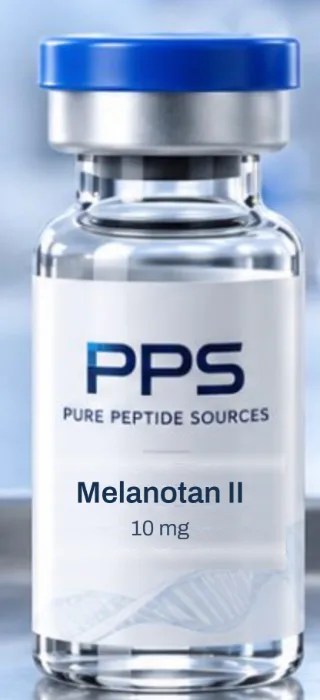
Melanotan I is the selective one: it isolates MC1R, so pigmentation research can be done without the other melanocortin receptors confounding the result. Melanotan II is non-selective and therefore reaches MC3R and MC4R as well, which is why its metabolite PT-141 became a separate compound studied for central melanocortin signalling.
| Property | Melanotan I | Melanotan II |
|---|---|---|
| Structure | Linear peptide | Cyclic lactam |
| Receptor selectivity | Selective for MC1R | Non-selective across melanocortin receptors |
| Molar mass | 1646.9 g/mol | 1024.2 g/mol |
| Also called | Afamelanotide | MT-2 |
| Research emphasis | Pigmentation pathways in isolation | Broader melanocortin signalling |
| Related compound | None in this catalogue | PT-141, a metabolite with MC3R and MC4R activity |
| Price | $78.00 · 10 mg | $72.00 · 10 mg |
10 mg
Linear alpha-MSH analogue, 10 mg per vial.
10 mg
Cyclic alpha-MSH analogue, 10 mg per vial.
Melanotan I. It is selective for MC1R, whereas Melanotan II acts across melanocortin receptors including MC3R and MC4R.
PT-141, bremelanotide, is a metabolite of Melanotan II. It retains MC3R and MC4R activity while having minimal pigmentation signalling, which is what made it a compound in its own right.
Melanotan II is a cyclic lactam, which constrains the molecule into a fixed conformation. Melanotan I is linear and considerably larger. The conformational difference is a major part of why their receptor selectivity differs.
All products listed are sold strictly for in-vitro laboratory research and analytical use. They are not drugs, foods, cosmetics or medical devices, and are not intended to diagnose, treat, cure or prevent any disease.
PPS assistant
Catalogue, handling, shipping and payment
Research use only. No dosing or medical advice. A person: Info@purepeptidesources.com